// News item
Microphone Types and Their Uses – A Practical Guide
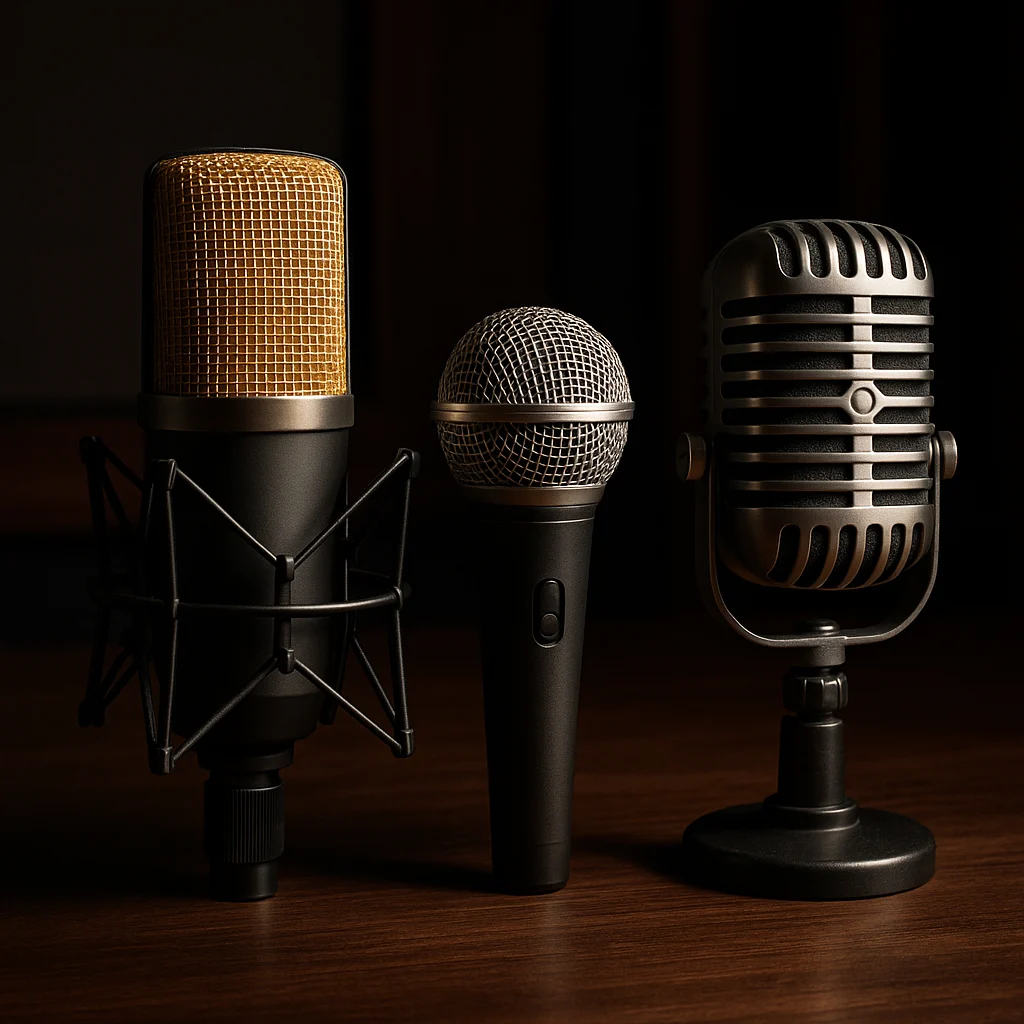
If you’ve ever tried selecting microphones for a production setup, you know the options can be pretty overwhelming. Dynamic, condenser, ribbon, USB – and we’re just getting started with the types. In practice, though, it’s simpler than you’d think: every microphone type has its place, and once you understand the basics, you can easily pick the right one for any situation. In this article, we’ll walk through the most important types and look at when to use each one.
Dynamic Microphones – Kings of the Stage
Dynamic microphones are the most robust tools in the palette. Their physical design is simple: a diaphragm moves a coil around a magnet, generating the signal. They don’t need phantom power (48V), they’re virtually indestructible, and they can handle truly high sound pressure levels without distorting.
That’s exactly why they’re loved at live performances. If a singer belts out full throttle into the mic, the dynamic microphone handles it with ease. Plus, due to the proximity effect, they deliver warmer, fuller bass when you sing close to them – which is actually an advantage in many genres.
Typical applications:
- Live vocals (Shure SM58, Sennheiser e835)
- Miking guitar and bass amplifiers (Shure SM57, Sennheiser e609)
- Drum kit: kick drum, snare, toms (Shure Beta 52A, Audix i5)
- Speech microphones for podcasting (Shure SM7B)
Their only disadvantage is that they’re not as detailed in the higher frequencies as condensers – but in many cases that’s actually a plus, because they’re less sensitive to unwanted noise.
Condenser Microphones – Studio Precision
Condenser microphones work on a completely different principle: the capacitance of two metal plates (condenser) changes in response to sound pressure, and this is converted into an electrical signal. However, this requires an external power source – usually 48V phantom power, provided by the mixer or audio interface.
Condensers are much more sensitive and can reproduce a wider frequency range. This means you get a cleaner, airier sound image with more detail in the highs. But precisely because of this, they’re also much more sensitive to ambient noise – every crackle, breath, machine hum can end up in the recording.
There are two main types:
- Large-diaphragm condensers (LDC): ideal for vocals and narration. They deliver a warm, rich sound image. (Neumann U87, Audio-Technica AT2020, Rode NT1-A)
- Small-diaphragm condensers (SDC): precise, suitable for capturing fast transients – perfect for acoustic instruments and overheads. (AKG C451, Rode NT5)
Use a condenser when:
- Recording vocals or instruments in the studio
- Clean, detailed sound is important
- Recording acoustic guitar, piano, strings
- Making choir or ensemble recordings with overhead technique
Important: condenser microphones must be handled carefully. They’re sensitive to moisture, impacts, and the capsule can be easily damaged – always keep them in a case and avoid sudden temperature changes.
Ribbon Microphones – The Vintage Renaissance
Ribbon microphones (ribbon mics) are among the oldest types, but they’ve experienced a renaissance in recent years. A thin metal ribbon floats in a magnetic field, and sound pressure moves it. The result: soft, warm, analog-character sound with gentle high-end roll-off.
Ribbon microphones work with a figure-8 polar pattern, meaning they pick up sound from the front and back, but less from the sides. This is particularly useful for paired techniques (e.g., Blumlein setup), or when you want to capture a soloist and the room’s ambience together.
When to choose a ribbon microphone:
- If you want vintage, analog-type sound
- For brass instruments (trumpet, saxophone), where a condenser would be too harsh
- For miking guitar amplifiers, if you’re avoiding aggressive sound
- For studio vocals, if you want a softer alternative to condensers
Important notes: Classic passive ribbon microphones have low output levels, requiring a high-quality, low-noise microphone preamp. New-generation active ribbon mics (e.g., Royer R-121, sE Electronics Voodoo), however, already work with 48V phantom power and are easier to handle. Caution: NEVER connect old passive ribbon microphones to phantom power – it can destroy the ribbon!
USB Microphones – Quick Solution for Content Creators
USB microphones are essentially mini studios in themselves: they come with built-in A/D converter, preamp, and sometimes even a headphone output. You connect a USB cable to your computer, and you’re good to go – no separate audio interface needed.
We recommend them for:
- Podcasters, content creators who want quick and clean sound
- Voiceover recordings in home environments
- Beginner musicians for recording demos
- Online teaching, streaming
USB microphones are generally made with condenser technology, and most are large-diaphragm. There are some really good quality ones among them (e.g., Rode NT-USB, Blue Yeti, Audio-Technica AT2020USB+), but it’s important to know: if you want to expand your setup later (e.g., use multiple microphones simultaneously), USB microphones impose limitations. That’s why many professionals recommend a good XLR microphone + an audio interface for the long term.
Polar Pattern – What Does It Mean and Why Is It Important?
Before buying any microphone, it makes sense to understand the polar pattern – that is, from where the microphone picks up sound.
- Cardioid (heart-shaped): picks up well from the front, attenuates from the sides and rear. This is the most common for live use and in the studio.
- Supercardioid / hypercardioid: narrower front pickup, slightly sensitive to the rear – good for monitor rejection in live settings.
- Omni (omnidirectional): picks up equally from all directions – perfect for room sound, ambient recordings.
- Figure-8: picks up front and back, not from the sides – ideal for interviews, duets, Blumlein stereo.
Many condenser microphones have switchable polar patterns, so you can try multiple recording techniques with one device.
Final Tips: How to Choose Wisely?
Don’t decide based on brand name alone – or at least not only because of it. A Shure SM58 dynamic microphone has been a proven standard for decades, but a cheaper condenser might still be better suited for a particular instrument. Listen to reference recordings, watch videos, and if possible, try the microphone with your own sound source.
What to consider:
- What environment will you use it in? (live / studio / home)
- What sound source do you want to record? (vocal / instrument / ambient)
- Do you have phantom power available? (mandatory for condensers)
- How important is portability and ruggedness?
And perhaps most important: a good microphone can greatly improve sound quality, but acoustics, microphone positioning, and recording technique are just as important. So don’t forget: equipment is just a tool – what matters is understanding how to use it.